
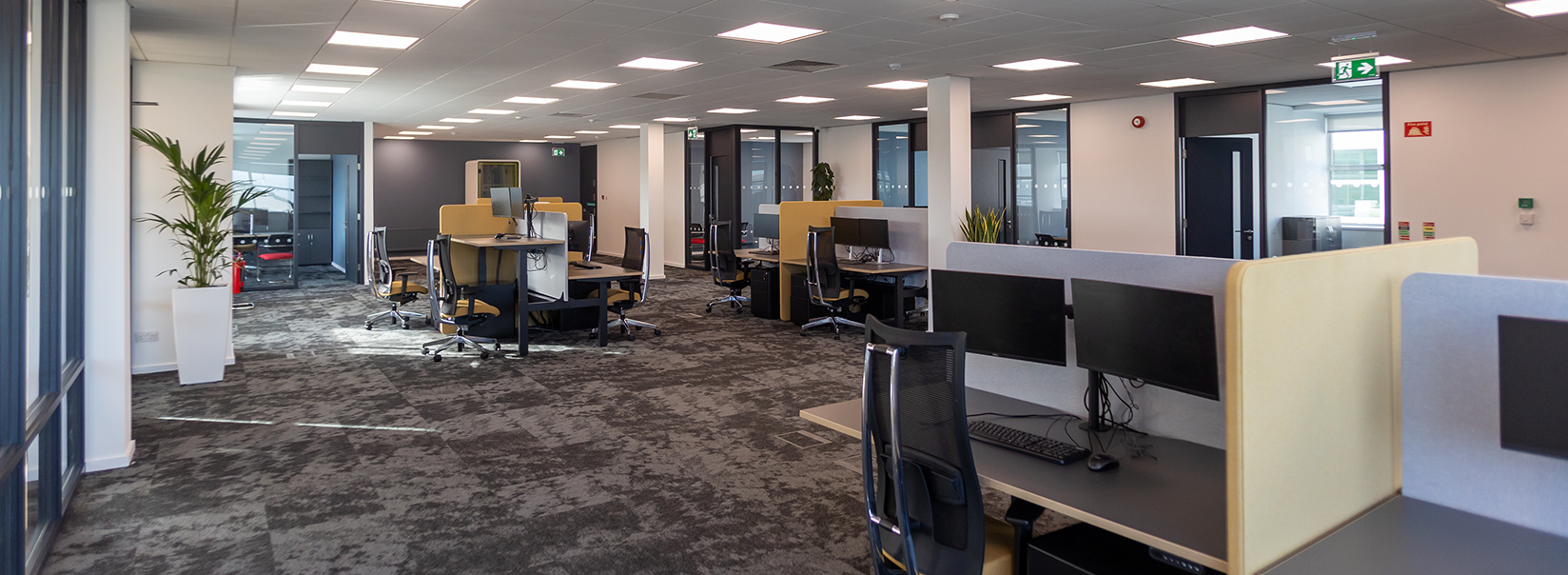
A Cat A office fit out is the starting point of a commercial workspace. It refers to a basic level of finish that prepares an office for occupation, but does not make it ready for day to day use. If you have ever walked into a newly leased office that looks clean, functional, yet completely empty, you have likely seen a Cat A office fit out in place.
For landlords, a Category A office fit out creates a blank canvas that can appeal to a wide range of tenants. For businesses, it offers flexibility to design a workspace that reflects their brand, culture, and way of working.
This guide explains exactly what a Cat A office fit out includes, what it does not include, and how it fits into the wider office design process.
Key Takeaways
- A Cat A office fit out provides a basic, functional office space ready for customisation
- It usually includes lighting, ceilings, flooring, and core services
- It does not include furniture, branding, or meeting spaces
- It is typically delivered by landlords before leasing a space
- Most businesses will need a Cat B fit out to make the office usable

In 2025, iGate Interiors completed a ‘Refresh Project for Calor Gas inlcuding elements of both Cat A and Cat B office fit out to accommodate the growing nature of the business, with a view to optimising space
Understanding a Cat A office fit out
What does Cat A office fit out mean?
A Cat A office fit out refers to the standard level of finish provided to a commercial office before a tenant moves in. It creates a clean, safe, and operational environment, but stops short of making the space fully usable.
Think of it as the shell of a workspace. The structure is there, the systems are working, and the space is compliant with building standards. What is missing is everything that makes the office feel like your office.
Why landlords typically deliver Cat A spaces
Landlords often invest in a Cat A office fit out to make their property more attractive to potential tenants. A finished but neutral space is far easier to lease than an empty shell.
It also allows flexibility. Different businesses have different needs, and a Cat A setup avoids limiting how the space can be used. One company may want open plan desks, while another may need multiple meeting rooms. Starting with a blank but functional space keeps all options open.

The key aim of H+K International’s office fit out project was to transform their team’s workspace experience & make it befitting of one of Ireland’s leading companies, in turn, achieving this by creating a bright, modern & collaborative workspace, befitting of a successful global company.
What is included in a Cat A office fit out?
Core building finishes and structure
A Cat A office fit out will typically include the fundamental elements that make the space usable from a structural point of view. This often covers internal walls, plastered surfaces, and a neutral finish throughout.
Floors are usually installed, though they may be basic. Raised access flooring is common in modern offices, allowing for easy cable management later on.
Mechanical and electrical installations
Heating, ventilation, and air conditioning systems are installed as part of a Cat A office fit out. These ensure the space is comfortable and compliant with regulations.
Electrical systems are also included. This covers power distribution, basic wiring, and essential infrastructure needed to support future office layouts.
Lighting, ceilings, and raised floors
Suspended ceilings with integrated lighting are a standard feature. These provide a clean and uniform appearance while allowing access to services above.
Lighting is typically functional rather than decorative. It is designed to meet general workplace standards rather than enhance a specific design scheme.
Basic welfare facilities
Most Cat A office fit outs include essential welfare facilities such as toilets and sometimes basic kitchen areas. These are often shared within the building rather than customised for individual tenants.
What is not included in a Cat A office fit out?
Furniture and branding elements
A Cat A office fit out does not include desks, chairs, or storage. It also excludes any branding, colour schemes, or design features that reflect a specific business identity.
This is where the space still feels unfinished. Without these elements, the office remains functional but lacks personality.
Meeting rooms and breakout spaces
Partitioning for meeting rooms, collaboration areas, or breakout zones is not part of a standard Cat A office fit out. The space is usually open plan, ready for a tailored layout.
If your business needs private rooms, office pods, or informal areas, these will be introduced during the next stage of the office fit out process.
Cat A vs Cat B office fit out explained
Key differences between Cat A and Cat B
The difference between Cat A and Cat B comes down to usability. A Cat A office fit out provides the basics, while Cat B turns the space into a working environment.
Cat B includes everything from furniture and partitioning to branding, technology, and finishes. It is the stage where the office becomes fully functional and aligned with your business needs.
Which option is right for your business?
Most businesses will not choose between Cat A and Cat B as alternatives. Instead, they are part of a sequence.
You begin with a cat A office fit out, then move into a category B office fit out project to complete the space. The level of detail in the Cat B stage will depend on your goals, team size, and working style.
Can you move straight into a cat A space?
Technically, yes. Practically, it is rarely a good idea.
A Cat A office fit out does not provide the infrastructure needed for daily operations. Without desks, meeting rooms, or storage, the space will not support productivity. Most businesses will require at least some level of additional work before moving in.
When does a Cat A office fit out make sense?
For landlords preparing a space for lease
A Cat A office fit out is most commonly used by landlords who want to present their property in the best possible light. It shows that the building is ready, compliant, and well maintained.
This approach can also reduce void periods by making the space more appealing to a broader audience.
For tenants planning a custom design later
For tenants, a Cat A office fit out offers flexibility. It allows you to design a workspace that suits your team rather than adapting to someone else’s layout.
Working with specialists such as iGate Interiors can help bridge the gap between a basic shell and a fully realised office. Their experience in commercial office fit out and 2D, 3D & VR office design can make the transition far smoother.
How much does a Cat A office fit out cost?
Typical cost factors to consider
The cost of a Cat A office fit out can vary depending on several factors. These include the size of the space, the condition of the building, and the level of specification required.
Other considerations include:
- Quality of materials used.
- Complexity of mechanical systems.
- Location of the building.
- Access and logistics.
If you are planning an office fit out project, it can help to review guides such as How Much Does an Office Fitout Cost? to understand typical budgets.
How location and building condition affect price
A modern building in good condition will usually require less work, reducing overall costs. Older properties may need upgrades to meet current standards, which can increase the investment required.
Location also plays a role. Labour, materials, and access can all vary depending on where the building is based.
Moving from Cat A to a finished workspace
A Category A office fit out is only the beginning. The real transformation happens when the space is tailored to your business.
This is where layout planning, furniture selection, and design come into play. Elements such as meeting booths, soft seating, and breakout areas areas all contribute to how the space functions on a daily basis.
Careful planning at this stage ensures the office supports productivity, collaboration, and employee wellbeing. It also helps avoid costly changes later on.
Common misconceptions about Cat A office fit out
Why “ready to move in” is often misunderstood
One of the most common misconceptions is that a category A office fit out means the space is ready to use. While it is technically ready for occupation, it is not ready for most businesses to operate effectively.
The lack of furniture, layout, and identity means additional work is almost always required. Understanding this early can help you plan timelines and budgets more accurately.
FAQs about Cat A office fit out
What is the difference between Cat A and Cat A+?
Cat A+ sits between Cat A and Cat B. It includes some additional features such as basic furniture and meeting rooms, making the space closer to move in ready.
How long does a Cat A office fit out take?
Timelines can vary depending on the size and complexity of the project. A typical cat A office fit out may take several weeks to a few months.
Is a Cat A office fit out suitable for small businesses?
Yes, particularly if you want flexibility. It allows smaller businesses to design a space that fits their exact needs rather than adapting to a pre designed layout.
Can a Cat A office be customised later?
Absolutely. In fact, that is the main purpose. A category A office fit out is designed to be adapted during the Cat B stage.
Do all offices come with Cat A fit out as standard?
Not always. Some spaces are delivered as shell and core, which means they require a full office fit out from the ground up. Others may already have a category A office fit out in place.

IGate Interiors’ extensive experience in collaborating with global teams across different time zones was pivotal in seamlessly working with GoFundMe’s San Francisco team and their chosen furniture supplier, KBM Hogue from Northern California.