
Meeting booths are a practical way to create quieter, more private spaces within a modern office. They give staff somewhere to talk, take calls, hold small meetings and focus on conversations without needing to book a large meeting room every time.
For many workplaces, this has become a real issue. Open plan offices are useful for teamwork, but they are not always ideal for confidential chats, hybrid meetings or quick discussions that need a little privacy. At the same time, traditional meeting rooms are often too large or too heavily booked for everyday conversations.
Meeting booths help fill that gap. They can make the office easier to use, reduce noise and give people more choice in how they work.
Key Takeaways
- Meeting booths create private spaces for calls, catch ups and small meetings.
They help reduce pressure on larger meeting rooms. - They are especially useful in hybrid offices where video calls happen throughout the day.
- The right meeting booth depends on size, comfort, acoustics, ventilation and placement.
- Hush Pods are a useful brand example of what acoustic office pods and booths can look like in practice.
- Meeting booths work best when they are planned as part of the wider office layout.


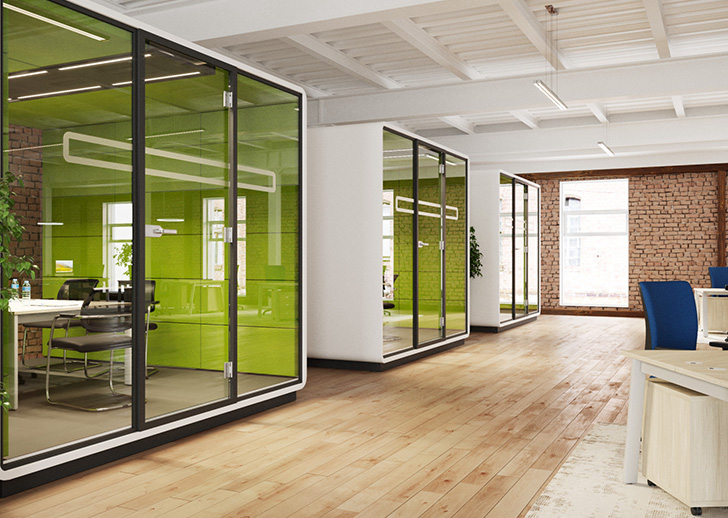
An example of how meeting booths can fit neatly into an office interior for maximum space efficiency.
iGate Interiors installed these meeting booths by Hush for Presidio’s European Headquarters.
What Are Meeting Booths?
Meeting booths are enclosed or semi enclosed spaces designed for small meetings, private conversations and video calls. They usually sit within an existing office layout and provide a quieter alternative to desks, breakout areas or traditional meeting rooms.
Some meeting booths are fully enclosed, with doors, built in lighting, ventilation, seating and power. Others are more open, using acoustic panels, high backed seating or booth style layouts to create a sense of separation without fully closing people away.
The purpose is simple. Meeting booths give people a better place to talk.

A Hush Office meeting booth iGate Interiors installed as part of a bespoke office fit out project for FBD Mullingar.
A practical definition
A meeting booth is a dedicated space for conversation. It might be used for a 1-to-1, a short project review, a client call, an interview, a quick planning session or a small hybrid meeting.
It sits somewhere between a desk and a formal meeting room. A desk can feel too public. A breakout sofa can feel too casual. A 10-person meeting room can feel excessive for 2 people and a laptop. Meeting booths solve that middle ground.
How meeting booths differ from office pods
The terms “office pods” and “meeting booths” are often used together, but they are not always exactly the same thing.
An office pod is the broader term. It can include phone pods, focus pods, acoustic pods and small meeting spaces. Meeting booths are more specific because they are usually designed around small group conversations.
A 1-person pod may be mainly for calls or focused work. A meeting booth is more likely to include seating for 2, 4 or 6 people, with a table and space for discussion. If you are comparing options, it helps to start with the purpose of the space rather than the product name.
Why Meeting Booths Are Becoming More Popular
Meeting booths have become more common because offices are now expected to do more. They need to support focused work, teamwork, video calls, private conversations, informal catch ups and client meetings.
That creates pressure on the layout. If every conversation depends on the same few meeting rooms, the office can quickly become frustrating.
Small meetings do not always need large rooms
Most offices have seen this problem. A large meeting room gets booked by 2 people for a 15-minute conversation, while a bigger group struggles to find somewhere suitable.
It is not usually anyone’s fault. People book what is available. If the only private space is a full meeting room, that is what they will use.
Meeting booths give staff a more suitable option. A 2-person or 4-person booth is often perfect for short discussions, which keeps larger rooms free for workshops, presentations, training and board meetings.
Open plan offices still need privacy
Open plan offices can support communication, but they need balance. Without quieter spaces, they can become noisy, distracting and uncomfortable.
Some conversations should not happen across a desk. A manager may need to speak privately with a team member. A sales person may need to call a client. A project team may need to discuss details without interrupting everyone nearby.
Meeting booths give staff somewhere to step away without leaving the office completely. That small amount of separation can make conversations feel easier and more natural.
Hybrid working has changed meeting habits
Hybrid working has made meeting booths even more useful. Many meetings now include a mix of people in the office and people joining remotely.
That means staff need quiet spaces with good lighting, power access and enough privacy to speak normally. Without these spaces, video calls often happen at desks, which can be distracting for the person on the call and everyone around them.
Meeting booths can make hybrid meetings feel more professional and less disruptive. They give people a clear place to go when they need to join a call, rather than turning the open plan office into a chorus of overlapping voices.
Where Meeting Booths Work Best In The Office
Meeting booths are most effective when they are placed carefully. A good booth in the wrong location may be underused, even if the product itself is well designed.
Placement should be based on how people move through the office, which teams need private spaces most often and where noise already builds up. This is why meeting booths are best considered during the space planning stage, not added at the last minute.
Near team areas
Meeting booths often work well near team areas because they give staff somewhere close by for quick discussions.
This is useful for project teams, managers and departments that need regular short conversations. The booth should be close enough to feel convenient, but not so close that people inside feel surrounded by desks.
Close to breakout spaces
Breakout areas are good for informal chats, but they are not always private. A meeting booth nearby can support conversations that start casually and then need more focus.
This creates a better mix of spaces. Sofas can support relaxed conversations. Meeting booths can support private discussions. Meeting rooms can support larger sessions.
Away from noisy routes
Meeting booths can improve acoustic comfort, but location still matters. A booth beside a kitchen entrance, printer station, reception route or busy corridor may not perform as well as expected.
The aim is to make the booth easy to access without placing it directly in the path of constant movement.
Part of the wider layout
Meeting booths should feel like part of the office, not random boxes placed wherever there is spare space.
Before choosing a location, think about walkways, sightlines, fire routes, power access, natural light, team zones and nearby meeting rooms. A booth should make the workplace easier to use, not harder to move around.
Choosing The Right Size Meeting Booth
The right size depends on how people actually meet. Bigger is not always better. A larger booth can look impressive, but it may waste space if most conversations involve only 2 or 3 people.
The best approach is to look at the meetings that happen most often. Daily calls, weekly reviews and quick team catch ups are usually more important than the occasional large meeting.
2-person meeting booths
A 2-person meeting booth is ideal for 1-to-1s, short calls, mentoring, interviews and private chats.
These booths are useful in offices where managers, sales teams or hybrid workers need somewhere quiet without taking over a full meeting room. They are compact, efficient and often easier to fit into a wider layout.
4-person meeting booths
A 4-person meeting booth is one of the most flexible options for many offices. It can support project catch ups, client calls, internal reviews and small planning sessions.
This size often gives a good balance between comfort and space efficiency. It is large enough to feel useful, but not so large that it becomes another formal meeting room.
6-person meeting booths
A 6-person meeting booth can work well when teams need more structured meeting space without building another room.
It can support team updates, project discussions and small presentations. It does need careful planning though. If most meetings are smaller, 2 smaller booths may be more useful than 1 larger booth.
Why bigger is not always better
The best meeting booths are based on real use. An oversized booth can sit empty because it feels too formal for quick chats. An undersized booth can feel cramped, which means staff avoid it.
Think about how long people will use the booth, how many people usually attend and whether they need laptops, screens or documents. Comfort matters as much as capacity.
What About Hush Pods?
If you are looking for a clear example of meeting booths in practice, the Hush Pods range by MikoMax is a useful reference point. The range helps show how acoustic pods and booths can work within a modern office interior. Hush have ranges that includes options for individual calls, quiet work and small group meetings.
Rather than being built into the office like a traditional meeting room, these pods sit within the wider layout. They can combine acoustic panels, built in ventilation, lighting and power within a freestanding structure.
This makes them a helpful example of the variety available. A business might need a single person booth for calls, a quiet pod for focused work or a larger meeting booth for small team discussions.
The Hush range can be a useful starting point, but the final choice should still come back to the workplace. The right meeting booth is the one that suits the team, the layout and the way the office is used day to day.

What To Consider Before Installing Meeting Booths
Meeting booths are usually easier to introduce than traditional rooms, but they still need proper thought. A poorly chosen booth can look good in photos but feel awkward in daily use.
Acoustic performance
Acoustics are one of the main reasons businesses choose meeting booths. A good acoustic booth can reduce noise and improve speech privacy.
It is important to be realistic though. Not every booth is fully soundproof. Performance depends on the product, materials, door seals, ventilation and surrounding office environment.
For most offices, the goal is practical privacy. People should be able to speak normally without feeling like every word is travelling across the room. If wider noise control is also an issue, acoustic panels may be worth considering as part of the overall design.
Ventilation and comfort
Ventilation is easy to overlook, but it has a big impact on whether people enjoy using the booth. A meeting booth needs to feel comfortable for more than a quick 5-minute chat.
Think about airflow, seating, table height, leg room and how long meetings usually last. A booth that feels stuffy or cramped will quickly become unpopular.
Power, screens and connectivity
Meeting booths used for hybrid meetings need power and connectivity. At a minimum, staff may need plug sockets and USB charging.
For regular video calls, it may be worth considering a screen, laptop connections and good camera positioning. The easier the booth is to use, the more likely staff are to use it properly.
Lighting and visibility
Good office lighting matters for comfort and video calls. A booth that feels dark or shadowy will not create the best experience.
Visibility also matters. Some meeting booths use glass panels to create openness while still providing acoustic separation. Others are more enclosed for privacy. The right choice depends on the office and the type of conversations taking place.
Meeting Booths Vs Traditional Meeting Rooms
Meeting booths are useful, but they are not a complete replacement for meeting rooms. Most offices benefit from having both.
The aim is to give people the right space for the task, rather than forcing every meeting into the same room.
When a meeting booth is enough
A meeting booth is often enough for quick team catch ups, client calls, small hybrid meetings, 1-to-1s and private conversations.
These are the meetings that often create pressure on larger rooms. By giving staff a smaller and more suitable option, meeting booths can make the whole office run more smoothly.
When a meeting room is still better
Traditional meeting rooms are still better for larger groups, training sessions, workshops, board meetings and formal presentations.
They offer more space, more flexibility and a more suitable setting for longer or more structured sessions. Meeting booths support everyday conversations, but they should not be expected to do everything.
Why many offices need both
A strong office layout usually includes a mix of spaces. Desks for focused work. Breakout areas for informal chats. Meeting booths for private small group conversations. Meeting rooms for larger sessions.
When these spaces work together, the office becomes easier to use and less frustrating.
Common Mistakes To Avoid With Meeting Booths
Meeting booths can solve a lot of everyday office problems, but only when they are chosen and planned properly.
Treating them as furniture only
A meeting booth is not only a furniture item. It affects acoustics, movement, behaviour and how people use the office.
It should be considered as part of the wider workplace design, especially during an office fit out or layout review.
Choosing style over comfort
A booth can look excellent but still feel poor in daily use. If the seating is awkward, the lighting is weak or the space feels cramped, people will avoid it.
Good meeting booths need to look right and feel right.
Ignoring real meeting habits
The best choice should be based on how people actually work. If most meetings involve 4 people, a single 2-person booth will not solve the issue. If most calls are individual, several smaller pods may be better.
Usage should guide the decision, not guesswork.
Forgetting the surrounding space
Even high quality meeting booths can feel wrong if they block walkways, sit in noisy corners or feel disconnected from the rest of the office.
The booth should support the flow of the workplace, not interrupt it.
Are Meeting Booths Right For Your Workplace?
Meeting booths may be worth considering if your office has any of these issues:
- Meeting rooms are always booked.
- Staff take video calls at their desks.
- Private conversations are difficult.
- Small meetings distract nearby teams.
- Larger rooms are regularly used by only 2 or 3 people.
- Hybrid meetings feel awkward.
- Breakout areas are being used for confidential chats.
The key is to identify the problem first. Meeting booths can improve privacy, reduce noise, support hybrid work and make better use of office space. They work best when they are part of a considered layout rather than a last minute addition.
For businesses reviewing their workplace interior design, meeting booths can be a practical way to add flexibility without completely rebuilding the office.

This small meeting booth was installed by iGate Interiors to create a private working or meeting area in an otherwise underutilised office space.
FAQs About Meeting Booths
Are meeting booths soundproof?
Many meeting booths offer strong acoustic performance, but not all are fully soundproof. A good booth can reduce noise and improve speech privacy, but the result depends on the product, installation and surrounding office environment.
How many people can use a meeting booth?
Common options include 2-person, 4-person and 6-person meeting booths. Larger meeting pods are also available for bigger groups, but the right size depends on how your team usually meets.
Are meeting booths suitable for video calls?
Yes. Meeting booths can be very useful for video calls, especially when they include good lighting, ventilation, power access and enough space for a laptop or screen.
Do meeting booths need planning permission?
In many office settings, meeting booths do not need planning permission in the same way structural building work might. It is still worth checking landlord rules, fire requirements and building restrictions before installation.
Can meeting booths be moved?
Many modular meeting booths can be moved, although this depends on the model, size and installation method. If your office may change in the future, ask about relocation before choosing a booth.
Are meeting booths better than meeting rooms?
Meeting booths are better for small, quick or regular conversations. Meeting rooms are still better for larger groups, workshops, training and formal presentations. Most modern offices benefit from having both.